Data Center Reference Model · Movement 6 · Your Place

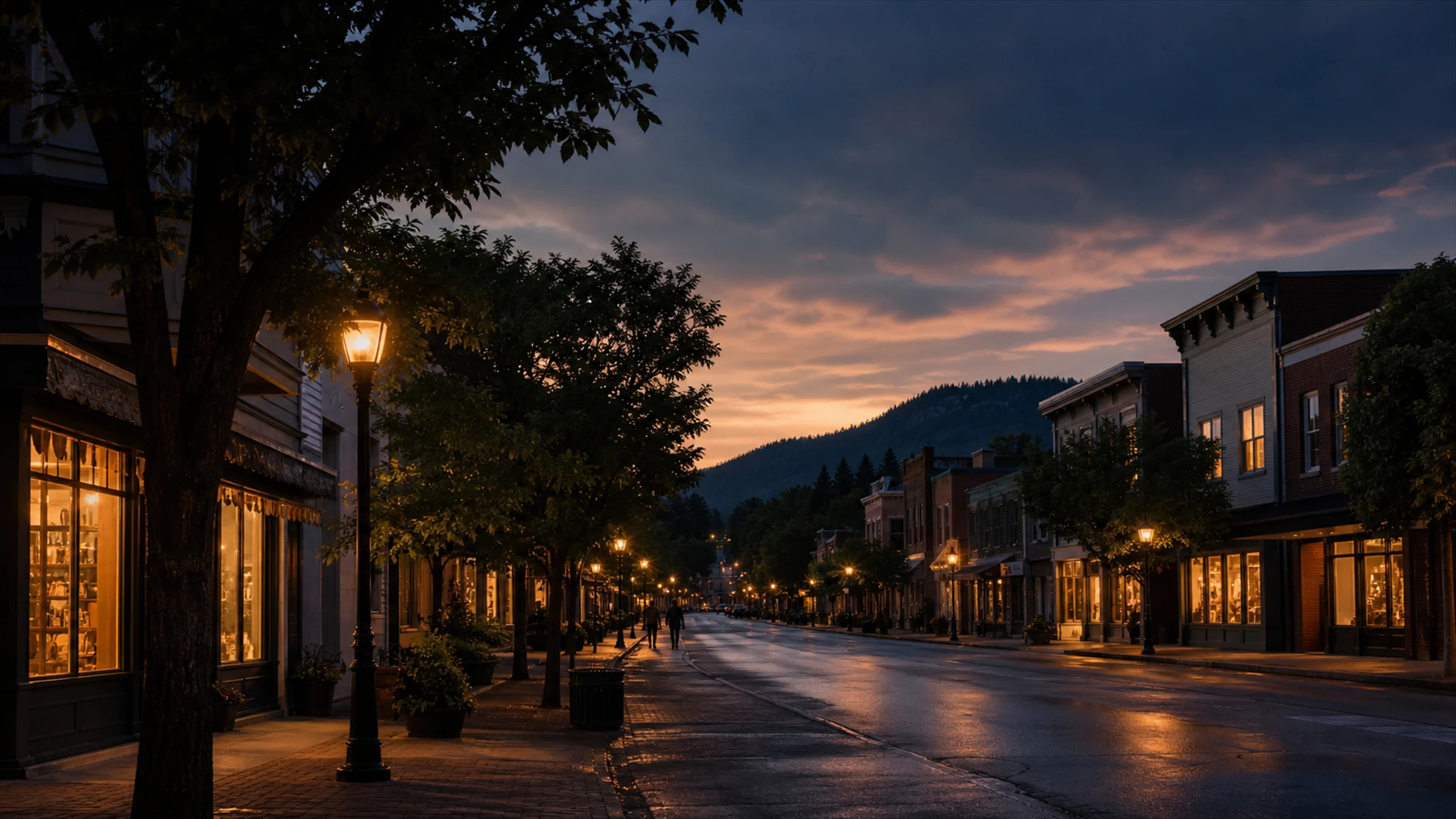
Would the town miss it?

It is the only question that matters. If this facility left in twenty years, would the town be relieved — or bereft? Build the plan that earns the second answer. Pick a real place, compose a stewardship portfolio from its own menu, and watch the Five Capitals balance move.
The plan comes first

The modeler sits behind the plan

Movement 6 starts with the plan of record. The sandbox is useful because it cannot silently rewrite that plan: it only explores, then an explicit promotion can turn a scenario into the next committed version.

Plan of record

The committed plan is the front door: the place, portfolio, covenant terms, and gates that decision-makers can review together.

What-if sandbox

The modeler sits behind the plan. You can try scenarios freely; those edits never touch the plan of record by themselves.

Explicit promotion

A scenario becomes the plan only when a person promotes it. That action is explicit and logged.

The reader is never handed a loose slider and asked to invent the project. The place produces a plan; the sandbox tests alternatives; promotion is deliberate and recorded.
The what-if sandbox

Five steps from a place to a plan

The sandbox composes a portfolio from the live catalog and runs it through the Balance Modeler engine — every figure it shows is computed, never authored.
1

Pick a place

Search a real place or drop a pin — the map suggests a climate band and you confirm every dimension. Your place answers its own questions.

2

Answer seven questions

A short interview sets facility scale, cooling approach, land situation, who you are, and what the place loves about itself.

3

Compose a portfolio

The geo-filtered menu opens. Add and scale interventions; watch synergies light up as compounding portfolios form.

4

Watch the balance

The Five Capitals beam and radar move in real time. Every number comes from the engine — none are hand-written.

5

Learn your stage & export

See your pathway stage, the exact gates you have met and missed, and export a Stewardship Profile you can carry into FEED.

A cold-climate place opens a cold menu — waste-heat district heating, greenhouses, snow-melt loops. A hot arid place opens an arid menu — zero-water cooling, aquifer recharge, agrivoltaics — and the heat-district options fall away. Same model, different place, different math.

Data Center Reference Model · Tab 5 · Place Planner

Would the Town Miss It?

Pick the place. Compose the portfolio. Watch the scales — then find your next gate on the Regenerative Pathway. All figures are Illustrative Examples.

Stage 1 · Extractive

Take and apologize. Standard build plus a community fund.

Balance ratio 1.6 (Illustrative)

Stewardship investment$4.5M – $21M

Illustrative capital cost of this portfolio — the project cost increase every party is signing up for, alongside the balance it buys.

  • On-site solar + storageHigh$12M
  • Story of Place process (pre-FEED)Medium$3.6M
  • Registered apprenticeshipsMedium$3.3M
  • Standing advisory board w/ decision rightsLow$450K

Per-capital coverage

Natural138%
Social225%
Human228%
Built132%
Financial92%

The Regenerative Pathway

  1. 1Extractive
  2. 2Mitigated
  3. 3Balanced
  4. 4Contributing
  5. 5Regenerative Anchor

Next gate → Mitigated

  • Offset ratio ≥ 0.25 (met)
  • A primary water-cooling item active (zero-water | closed-loop liquid) (not yet met)
  • An embodied-carbon / hardware-reuse disclosure item active (EPD | hardware reuse) (met)

Recommended next moves

Your next step

Bring this Stewardship Profile to your FEED stage — the place writes the spec before FID locks it.

Get a data-center report for this place

Draft an honest, sourced report for A sample place (Temperate · moderate stress · metro) at 150 MW — the imbalance context, place-based opportunities, the stewardship pathway, and Five Capitals framing. Every figure is cited or marked Illustrative Example. This also registers the planned place as a project.

How an engagement works

  1. Story of Place discovery2–4 months (Illustrative) · Gate: The community recognizes its own story in the brief and agrees it is ready to test readiness.
  2. Readiness Gates1–3 months (Illustrative) · Gate: All three readiness gates pass in public session — or the engagement pauses honestly at the one that failed.
  3. Design — the place writes the spec3–6 months (Illustrative) · Gate: FID is taken on the place-authored spec — the portfolio is in the base design, not an appendix.
  4. Covenant — commitments with teeth1–2 months (Illustrative) · Gate: Covenants are executed and published in the registry before ground breaks.
  5. Verify & StewardAnnual cycle, life of facility (Illustrative) · Gate: Each year's whole-place accounting is published and independently verified — the gate never closes; that is stewardship.

Illustrative Example — the deterministic engine owns every number; nothing here is a performance claim. Precedent flags: OPERATING = verified operating project · PILOT = documented pilot · PROPOSAL = concept with adjacent precedent only.

The community benefit is a structural gate

A benefit agreement is architecture, not public relations

What separates a durable plan from a press release is enforcement, proportion, governance, and consent. These are the four things the Planner asks you to make real.

Clawback-secured commitments

A community benefit is only as real as its enforcement. Lancaster County secured its agreement with a ~$10M letter of credit — while noting flexible-language gaps in the qualitative promises.Lancaster County CBA reportingCommunity benefits agreement secured by a ~$10M letter of credit plus a comprehensive e-waste planFlexible-language gaps in the drafted commitments have been noted; a letter of credit secures payment, not every qualitative promise.2024View source ↗ A letter of credit secures payment; it does not secure a vague sentence.

Scale to the host, not the headline

Byron, NY — a town of fewer than 3,000 — reportedly negotiated roughly $25M over 20 years.Town of Byron, NY reportingHost-community agreement reported at roughly $25M over 20 years for a town of fewer than 3,000 residents2024View source ↗ The test is not the absolute dollar figure; it is whether the benefit is proportionate to what the place carries.

Govern the fund, publish the terms

Benefit funds work when a standing community body holds decision rights and the terms are public. The no-NDA principle is load-bearing: secrecy is where trust goes to die, and where counter-cases like the xAI Memphis dispute begin.

FPIC where Indigenous land or water is touched

Free, prior, and informed consent is not an add-on. Where a project touches Indigenous land or water, FPIC is the gate — not a courtesy consultation after the design is fixed.

What you come away with

Three readers, one covenant

One journey. One covenant. Three reasons to walk it.
Mayor / community

The one project I can champion — and be proud of in twenty years.

Builder

Permission stops being my critical path. Faster to FID, not slower.

AI operator

Scale and speed, with the community as co-owner and a story that survives scrutiny.

A data center the town would miss if it were gone. That's the whole idea.

Life before Profits.

Illustrative model. The Regen Data Center is an educational reference model. Figures shown are either externally cited or tagged as illustrative examples; interactive outputs are illustrative and not offers, financial advice, or guarantees. Operating, announced, and proposal precedents are labeled distinctly throughout. Nothing here recognizes, certifies, or constitutes a VLAS-verified asset.

Regen Data Center · v0.15.1